


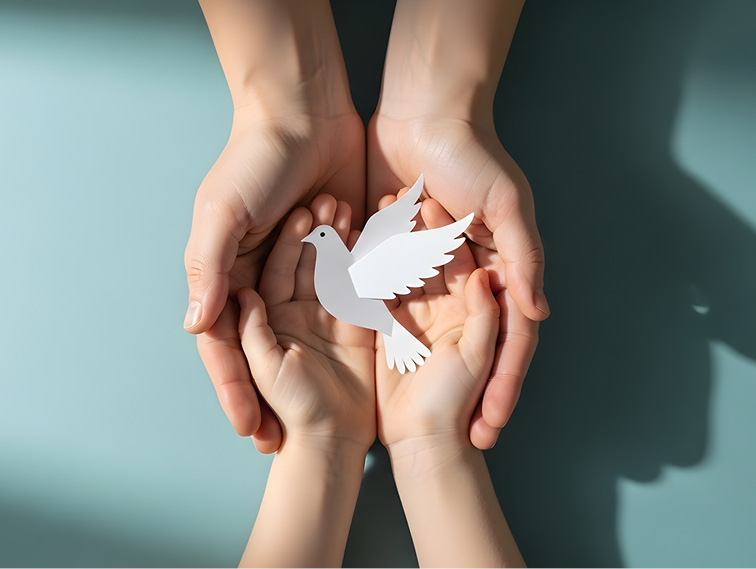
Prof. Gross conceptualizes peace education not as conflict avoidance, but as the ethical management of disagreement within democratic societies. Her research explores youth identity construction, civic resilience, and intergroup dialogue in polarized and post-conflict environments.
The laboratory develops immersive simulation environments and AI-supported deliberative tools that recreate complex civic and political dilemmas. These structured interventions allow adolescents and university students to engage in negotiation, perspective-taking, and democratic practice in experientially rich learning contexts.
Selected Publications
Her work contributes to comparative education, political philosophy of education, and social cohesion research, offering empirically grounded models for fostering democratic engagement without erasing ideological diversity.
Peace Education
In peace education, Prof. Zehavit Gross advances a theoretically grounded and empirically robust paradigm that reconceptualizes peace not as consensus or the absence of conflict, but as the ethical management of disagreement within democratic life. Her scholarship integrates political philosophy, comparative education, and longitudinal empirical research on adolescents and university students living in polarized and post-conflict societies.
Her work examines identity negotiation, civic resilience, intergroup dialogue, and educational responses to social fragmentation. Through qualitative and longitudinal studies, she analyzes how young people construct civic responsibility and democratic agency in contexts shaped by national, religious, and cultural tensions. Her contributions have influenced international theoretical debates on democratic education, conflict engagement, and social cohesion, offering innovative frameworks that sustain pluralism without erasing ideological difference.
Methodologically, the laboratory combines rigorous research design with intervention-based innovation. It integrates immersive simulations, AI-supported deliberative platforms, and PhotoVoice participatory visual inquiry as complementary tools for both research and pedagogy.
Through simulation-based learning environments, students engage in structured conflict scenarios, democratic negotiations, and ethically complex decision-making processes that mirror real-world tensions. Through PhotoVoice methodology, participants visually document and narrate lived experiences of division, coexistence, exclusion, and hope — transforming individual perception into collective dialogue and critical reflection.
By uniting immersive technologies with participatory visual research, the laboratory develops scalable peace education models that foster critical consciousness, empathy, civic agency, and democratic resilience. These models position educational institutions as active spaces of democratic repair, strengthening social cohesion while engaging, rather than silencing, difference.
B. Peace Education, Conflict, Social Cohesion, and Civic/Intergroup Relations
Books (Editor)
- Iram, Y., Wharman, H., & Gross, Z. (Eds.). (2006). Educating toward a culture of peace. IAP.
- Gross, Z., & Davies, L. (Eds.). (2015). The contested role of education in conflict and fragility. Sense.
- Yitzhaki, D., Aloni, N., Gallagher, T., & Gross, Z. (Eds.). (2022). Activist pedagogy and shared education in divided societies. Brill/Sense.
Chapters in Books (Selected)
- Gross, Z. (2006). Voices among the religious Zionist… peace process and disengagement. In Educating toward a culture of peace (pp. 259–279). IAP.
- Gross, Z. (2010). Facilitating a moral journey in a university setting… In International research handbook on values education and student wellbeing (pp. 947–957). Springer.
- Gross, Z. (2013). Educating for harmony in conflict settings: A case study. In J. Arthur & T. Lovat (Eds.), Routledge international handbook of education, religion and values (pp. 326–336). Routledge.
- Gross, Z. (2015). The place of contestation in conflict education. In The contested role of education in conflict and fragility (pp. 13–28). Sense.
- Gross, Z. (2015). Coping with complex identities… university students in a conflict resolution course. In The contested role… (pp. 155–170). Sense.
- Gross, Z. (2020). Facilitating coexistence between Palestinian Arab and Jewish students… In A. Mana & A. Srour (Eds.), Israeli and Palestinian collective narratives in conflict (pp. 268–287). Cambridge Scholars.
- Gross, Z. (2022). Contestation… activist pedagogy. In Activist pedagogy and shared education… (pp. 171–186). Brill.
- Gross, Z. (2023). Peace education, pedagogy of contestation and activist pedagogy in higher education in Israel. In D. Court & R. Abbas (Eds.), Social justice in multicultural settings. Cambridge Scholars.
Articles in Refereed Journals (Selected)
- Gross, Z. (2008). Relocation in rural and urban settings… uprooted schools from Gaza Strip. Education & Urban Society, 40(2), 269–295.
- Gross, Z. (2012). The teacher as a common enemy… Educational Practice and Theory, 34(1), 81–95.
- Gross, Z., & Gamal, E. (2014). How Muslim Arab Israeli teachers conceptualize conflict in class. Studies in Philosophy and Education, 33(3), 267–281.
- Gross, Z. (2017). Revisiting peace education… Introduction. Research in Comparative and International Education, 12(1), 3–8.
- Gross, Z. (2017). Building peace… case study from Israel. Research in Comparative and International Education, 12(1), 64–75.
- Saada, N., & Gross, Z. (2019). Arab teachers in Jewish schools in Israel. Teaching and Teacher Education, 79, 198–207.
- Gross, Z., & Maor, R. (2020). Contact theory in acute asymmetrical violent conflict… Peace and Conflict: Journal of Peace Psychology.
- Amram Asherov, E., & Gross, Z. (2024). Community coherence… civic engagement in youth councils. Children & Society, 38(6), 1943–1964.
- Masry-Herzallah, A., Sarhan, H., & Gross, Z. (2025). Transformational leadership and technological competence in non-formal education. International Journal of Instruction, 18(2), 143–166.
- Masry-Herzallah, A., Sarhan, H., & Gross, Z. (accepted). Leadership styles and remote work dynamics… Education Sciences.