


How are molecules created, destroyed and how do they cool down in the interstellar medium
Laboratory astrophysics refers to laboratory experiments which help in identifying molecules in space, as well as understand the life-cycle of these molecules: how are they create? How are they destroyed? How do they evolve with time?
The cryogenic storage ring (CSR) 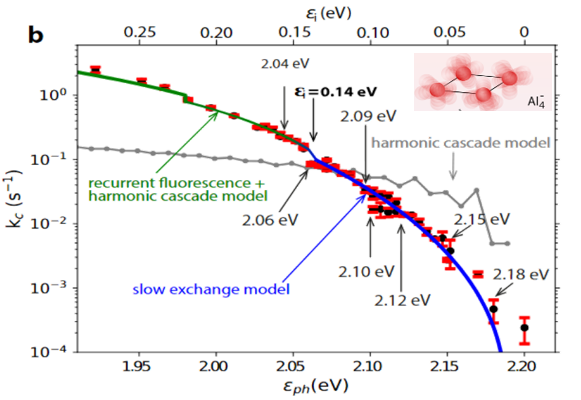
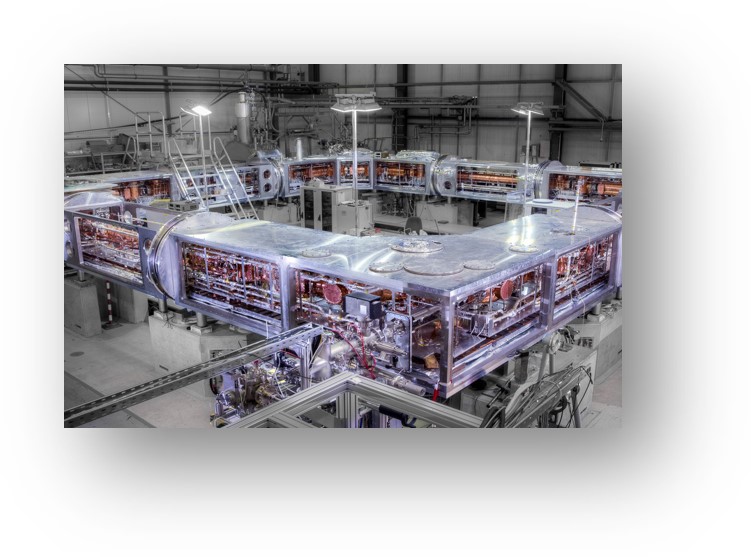
Our group has a strong collaboration with the MPIK in Heidelberg which hosts one of the most sophisticated tools for laboratory astrophysics: the cryogenic storage ring (CSR).
The CSR is a 35 m in circumference electrostatic storage ring which is cooled down to a few degrees Kelvin, allowing to study astrophyscially relevant molecules in the low pressures and low temperatures which are typicall of the interstellar medium.
Radiative cooling of isolated molecules
How do symmetric molecules cool down in the interstellar medium? Symmetric molecules have IR forbiden transitions, and therefore their vibrational radiative cooling is possible only if there is a mechanism to transfer energy from the inactive to active vibrational modes. This mechanism is called intramolecular vibrational redistribution (IVR)
We have been studying the radiative cooling of small aluminum clusters in the CSR, which tell a fascinating story about vibrational cooling and IVR.
Photoelectron spectroscopy using the CSR-ReMi
The third striaght section of the CSR hosts a reaction microscope (CSR-ReMi) whose primary goal is to study collisions between the ions stored in the ring and neutral atoms/molecules from a gas jet. We are working on using the CSR-ReMi in velocity map imaging mode (VMI) in order to be able to perform photoelectron spectroscopy (PES) studies of the stored ions, as well as to study thermionic emission.