


Most of the molecules in our body are transparent to visible light. The small family of molecules that interact with visible light are called biochromophores. They are responsible for the colors flowers, for photosynthesis, vision, bioluminesce and have many uses in science and technology for example for flourescent marker for microscopy.
Understanding the quantum mechanical basis for their function is difficult because the chromophores natural environment is within complex proteints. The action spectroscopy approach is to begin by studying isolated chromophores - with no surronding - to understand their intrinsic optical properties. In the next stage we gradually introduce interactions in a stepwise fashion.
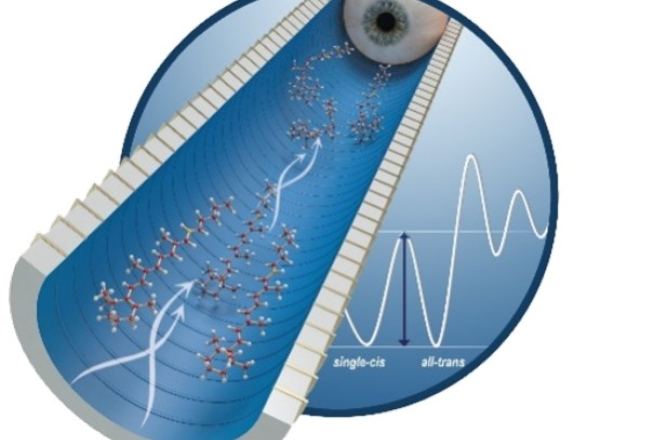
We have made many studies of the retinal protonated Schiff base which is the chromophore responsible for all forms of animal vision. We have studied its isomerization dynamics using Ion Mobility Spectroscopy, and helped understand its color tuning mechanisms - showing that complexation of the chromophore with betaine (a molecule with an extremely large dipole moment) causes a huge shift to its photon absorption band.
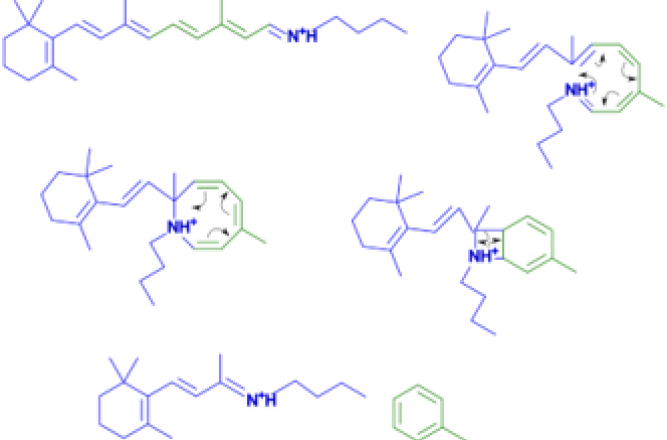
Upon photon absorption the retinal chromophore has one prominent fragementation prodcut which doesn't correspond to severing any single bond within the molecule. Rather, it correspond to emission of the central part of the chromophore while 'tying' together its two ends. This is done through a series of isomerizations and cylcization. This is the type of dynamical studies we are conducing based on fragmentation pattern measurements.