


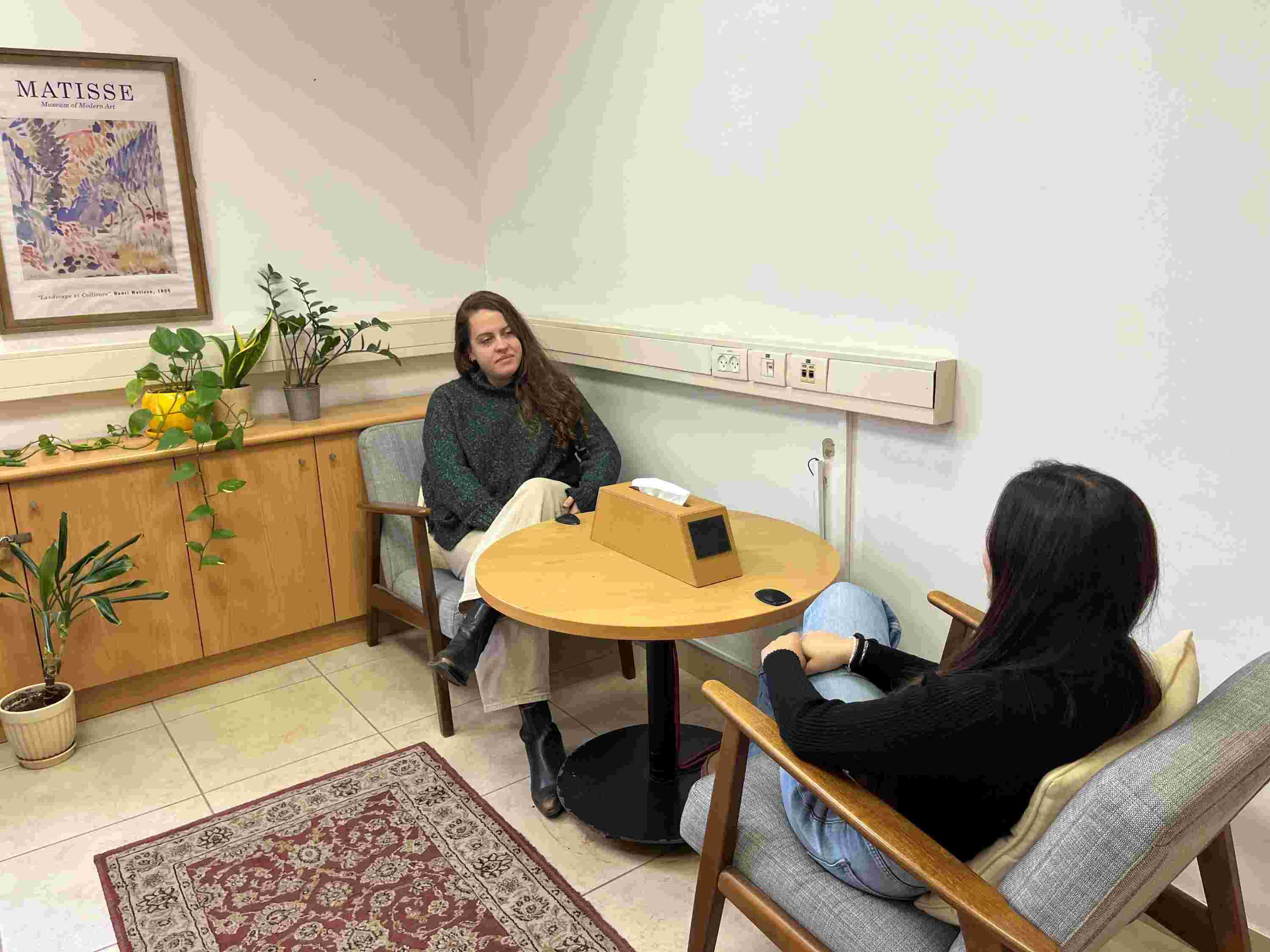
In-session synchrony and co-regulation: how coordination in the therapeutic relationship shapes outcomes.
Alongside the intrapersonal dynamics, psychotherapy is a fundamentally relational process: change unfolds through ongoing, moment-to-moment mutual influence between patient and therapist. This synchronization is expressed through the verbal and nonverbal channels, including speech, vocal cues, facial expressions, and physiology. These coordinated patterns can support co-regulation, helping patients regain emotional homeostasis in ways that promote therapeutic progress. Our lab has led research on multimodal in-session synchrony, flexible synchrony, and co-regulation, using advanced computational methods, to examine moment-by-moment patient-therapist interactions that drive positive change.
Our systematic review and meta-analysis (Atzil-Slonim et al., 2023) emphasized the importance of context in determining when synchrony is beneficial and when it may not be. In one study (Bar-Kalifa et al., 2023), we measured physiological synchrony between patients and therapists while accounting for emotional context. Synchrony during productive emotional experiences was linked to patients’ favorable session evaluations, whereas synchrony during unproductive moments was not. Additionally, our studies suggested that the benefits of synchrony depend on other factors, such as therapists’ ability to induce coregulation patterns (Paz et al., 2021; 2025), or the dyad’s ability to flexibly go in and out of synchrony (Sayda et al., 2026).
References:
Atzil-Slonim, D., Soma, C. S., Zhang, X., Paz, A., & Imel, Z. E. (2023). Facilitating dyadic synchrony in psychotherapy sessions: Systematic review and meta-analysis. Psychotherapy Research, 33(7), 898-917.
Bar-Kalifa, E., Goren, O., Gilboa-Schechtman, E., Wolff, M., Rafael, D., Heimann, S., ... & Atzil-Slonim, D. (2023). Clients’ emotional experience as a dynamic context for client–therapist physiological synchrony. Journal of Consulting and Clinical Psychology, 91(6), 367.
Paz, A., Rafaeli, E., Bar-Kalifa, E., Gilboa-Schechtman, E., Gannot, S., Narayanan, S., & Atzil-Slonim, D. (2025). Dampening versus amplification: Intrapersonal and interpersonal vocal affect dynamics during psychotherapy for depression. Psychotherapy Research, 1-14.
Paz, A., Rafaeli, E., Bar-Kalifa, E., Gilboa-Schectman, E., Gannot, S., Laufer-Goldshtein, B., ... & Atzil-Slonim, D. (2021). Intrapersonal and interpersonal vocal affect dynamics during psychotherapy. Journal of Consulting and Clinical Psychology, 89(3), 227.
Sayda, D., Bar-Kalifa, E., Gordon, I., & Atzil-Slonim, D. (2026). Flexible and multimodal synchrony during psychotherapy for depression: Addressing the mixed synchrony–outcome findings. Journal of Counseling Psychology.