

The sedimentology and portable luminescence laboratory at BIU provides an ideal setting for bulk luminescence measurements of natural and anthropogenic Quaternary sediments. The field equipment is mainly geared for measuring, describing and collecting samples and can serve for a broad range of geomorphological and archeological research. The laboratory results serve for in-house and out-house, Israeli and global academic and government research projects.
We are open to collaborations and offer research opportunities for students (M.Sc / MA / Ph.D. / post-Doc).
The goal of the laboratory is to rapidly provide interpretation of geomorphic and geoarchaeological-associated processes and rates predominantly during the Quaternary, by analyzing:
- the sedimentological and geochemical properties, and signatures of sediments of all types.
- By port-luminescence measurements to determine relative age of sediments, basic mineralogical uniformity and screen for full OSL dating.
Israel Port-OSL Research Group (IP-OSLRG)
The group, founded in 2026 consists of the three major port-OSL researchers and luminescence dating experts in Israel.
A workshop is planned for September 16th, 2026 at Ariel University.

National Archive of Quaternary Sediments (NAQS)
The archive is a national collection of sediments and soils from the Israel and the southern Levant, maintained in the Sedimentology-Luminescence Laboratory at Bar-Ilan University. It preserves ancient soils, anthropogenic agricultural soils, and wind-, river-, and water-body deposits such as sand, loess, dust, and stream sediments. These materials document past environments, climate change, human activity, and geomorphological processes, and provide a foundation for future research as many sites are being altered by construction and intensive agriculture. The archive supports collaborations with research institutions in Israel and abroad.
Government and Academic Institutes with research cooperation
Laboratory History
The laboratory was established following funding by an ISF-NSFC (China) grant on aeolian-fluvial interactions at the Leon Recanati Institute, University of Haifa. The lab was initially called the Geomorphology and Portable Luminescence Laboratory. The lab was equipped with the SUERC port-OSL reader in Israel (now there are four readers in Israel). Then, Joel Roskin was a research associate. The laboratory was developed and managed by Dr. Lotem Robins then doing his Ph.D. M.A candidate Omri Ilan and now Dr. Amir Bar served as part-time lab technicians. As part of his qualifications for the lab, Lotem completed a tailored course on the portable-OSL reader at SUERC in Scotland with Prof. David Sanderson. Lotem established port-OSL measurement protocols and has developed Python-based programs for analyzing analytical data.
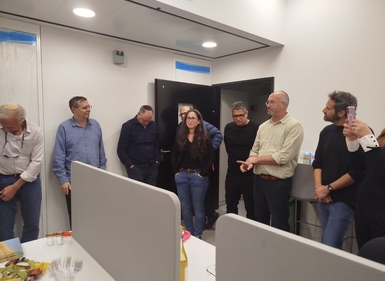
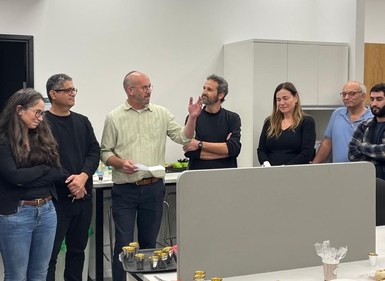
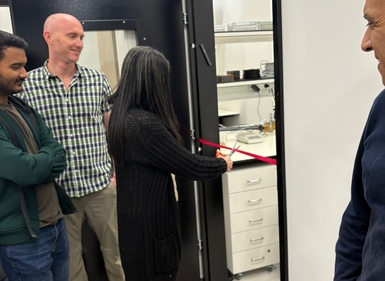
In early 2025, the Sedimentology and Portable Luminescence Laboratory was inaugurated at Bar-Ilan University, joining the Environmental radio-isotope lab, Soil and Geomorphology, and Environmental Hydrology laboratories.
Since then, the lab has been accumulating a lot of sediments that have evolved in collaboration with other institutions, the emerging National Archive of Quaternary Sediments (NAQS).
Lab Opening Event