


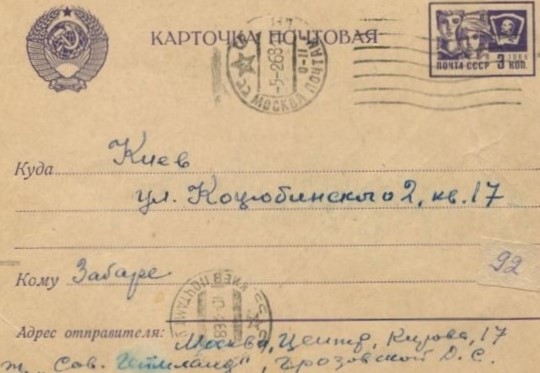
DATE: Feb 5, 1968 (according to the post stamp for the first letter)
ROUTE: Moscow to Kiev
LANGUAGE: Yiddish (Soviet orthography)
SOURCE: Center for the Studies of History and Culture of East European Jewry (Judaica Center)
Rg: 92
ASSOCIATES:
Moyshe Olgin (Moyshe-Yoysef Novominsky)
SUBJECTS:
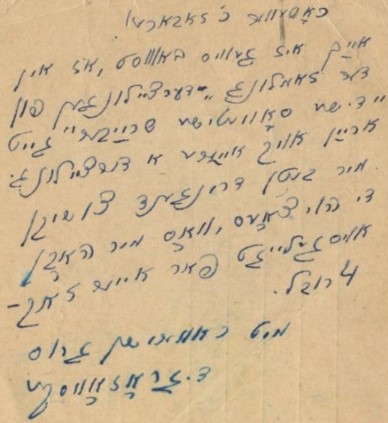
כאָשעווער כ' זאבארע!
אײַך איז געוויס באוווּסט, אז אין דער זאמלונג "דערציילונגען פון ייִדישע סאָוועטישע שרײַבער" גייט ארײַן אויך אײַערע א דערציילונג. מיר בעטן דרינגענד צו שיקן די הויצאָעס, וואָס מיר האָבן אויסגעלייגט פאר אײַער זאך – 4 רובל.
מיט כאווערישן גרוס,
ד. גראָזאָווסקע
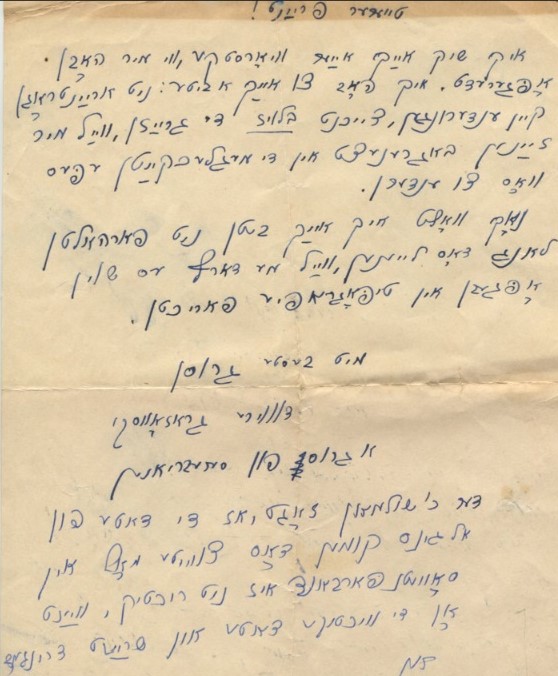
טײַערער פרײַנט!
איך שיק אײַך אײַער וויאָרסטקע, ווי מיר האָבן אָפּגערעדט. איך האָב צו אײַך א ביטע: ניט ארײַנטראָגן קיין ענדערונגען, צייכנט בלויז די גרײַזן, ווײַל מיר זײַנען באגרענעצט אין די מעגלעכקייטן עפּעס וואָס צו ענדערן.
נאָך וואָלט איך אײַך בעטן ניט פארהאלטן לאנג דאָס לייענען, ווײַל מע דארף עס שוין אָפּגעבן אין טיפּאָגראפיע פאריכטן.
מיט בעסטע גרוסן,
דוווירע גראָזאָווסקי
א גרוס פון סערעבריאנען
דער כ' שולמאן זאָגט, אז די דאטע פון אָלגינס קומען דאָס צווייטע מאָל אין סאָוועטנפארבאנד איז ניט ריכטיק
ווײַזט אָן די ריכטיקע דאטע און שרײַבט דרינגענד דאָ.
CONTENT
This file combines two letters on the same subject. Dvoyre Grozovska (the Moscow-based proofreader for the Sovetish Heymland Yiddish literary journal and the Sovetskiy Pisatel' book publisher and the Yiddish writer Yisroel Serebryani's wife) updates Zabara on the progress in her job: preparing the collection Dertseylungen fun yidishe sovetishe shrayber [Stories of Jewish Soviet Writers] to print.
The first message concerns a financial matter. It is unclear whether the author is being asked to prepare an itemized record of expenses related to the processing of his story, adjusting them to a specified amount of four rubles (possibly for the publishing house’s financial reporting), or whether he is required to reimburse the publisher’s expenses instead of receiving a fee or royalties.
In the second message, the writer is asked to review the preliminary layout of his story. The sender informs the addressee that no further changes to the content are possible: the text has already been edited and, most likely, censored. The proofreader, in an informal and apologetic tone, explains that the author may only check the layout for grammatical errors and typographical mistakes.
The sender also informs that Moyni Shulman has found a minor historical inaccuracy in the story re. the American Yiddish activist Moyshe Olgin to be corrected by the author.
FACTS AND EVENTS
![Dertseylungen fun yidishe sovetishe shrayber [Stories of Yiddish Soviet Writers]](/sites/default/files/inline-images/derceylungen_0.jpg) The Yiddish prose collection Dertseylungen fun yidishe sovetishe shrayber [Stories of Yiddish Soviet Writers] was published in Moscow in 1969. The letter was written just between the book's submission to typesetting and its affirmation for printing. More than 60 authors appear in the book. The Sovetskiy Pisatel' [The Soviet Writer] publisher, which issued the book, was the only one in the USSR to deal with Yiddish fiction in that era.
The Yiddish prose collection Dertseylungen fun yidishe sovetishe shrayber [Stories of Yiddish Soviet Writers] was published in Moscow in 1969. The letter was written just between the book's submission to typesetting and its affirmation for printing. More than 60 authors appear in the book. The Sovetskiy Pisatel' [The Soviet Writer] publisher, which issued the book, was the only one in the USSR to deal with Yiddish fiction in that era.
Zabara is represented here by the historical quasi-documentary story Af gekreytste vegn [On Crossing Paths] (pp. 367-381), written in 1966. It describes the meeting between the prominent Ukrainian writer Lesya Ukrainka and the Hebrew novelist Mordecai Ze’ev Feierberg, who also lived in Ukraine.
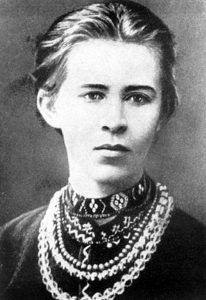
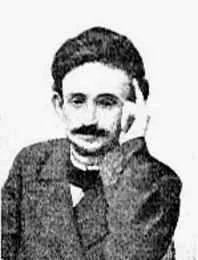
Hebrew literature was virtually a taboo subject in Soviet Yiddish writing. By contrast, emphasizing connections with Ukrainian culture was encouraged in the USSR at the time, particularly when it involved the portrayal of joint pro-Communist activities. Zabara’s story exemplifies this tendency, depicting the translation of revolutionary propaganda materials.
It can be conveyed from the second letter that Moyni Shulman, the erudite journalist, editor, and lexicographer who lived then in Moscow, participated in the publishers' editing work on the collection, though he is not mentioned in the book credits (maybe due to his strained relationship with the influential editor-in-chief of Sovetish Heymland, Arn Vergelis). The Moscow-based Yiddish writer Tevye Gen is only listed as its editor.
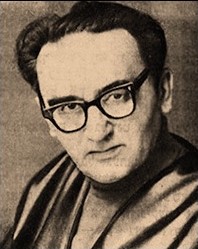
In Zabara's story, the American Yiddish writer, editor, and political activist Moyshe Olgin (Novominski) is mentioned. Shulman found the inaccurate dating of Olgin's visit in the USSR. Given the claimed historical character of the narrative, it is considered an error.
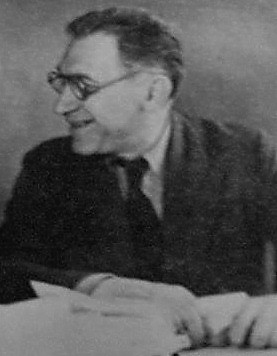
Grozovska's husband, the Yiddish literary critic, translator, and bibliographer Yisroel Serebryani, corresponded with Zabara on this issue separately.