


DATE: Sep 5, 1968
ROUTE: Irpin to Kiev
LANGUAGE: Yiddish (Soviet orthography)
SOURCE: Center for the Studies of History and Culture of East European Jewry (Judaica Center)
Rg: 98
ASSOCIATES:
Dvoyre Grozovska
SUBJECTS:
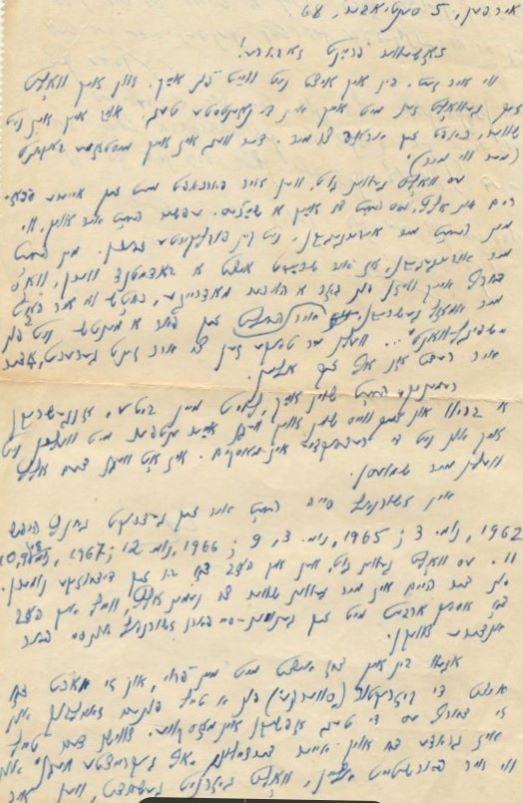
אירפּען, 5 סענטיאבער 1968
כאָשעווער פרײַנט זאבארע!
ווי איר זעט, בין איך איצט ניט ווײַט פון אײַך, און איך וואָלט זיך געוואָלט זען מיט אײַך אין די נאָענטסטע טעג. אויב אײַך איז ניט שווער, כאפּט זיך אראָפּ צו מיר. דער וועג איז אײַך מיסטאָמע באקאנט (מער ווי מיר)
עס וואָלט געווען גוט, ווען איר פארכאפּט מיט זיך אײַערע ספאָרים און אלץ, וואָס האָט צו אײַך א שײַכעס. עפשער האָט איר אלץ, ווי מען האָט מיר איבערגעגעבן, ניט קיין פּובליקירטע זאכן. מען האָט מיר איבערגעגעבן, אז איר שרײַבט איצט א באדײַטנדע ווערק, וואָס דארף אײַך ווײַזן אף גאָר א הויכער מאדרייגע, כאָטש ווי איר האָט מיר אמאָל געשריבן, האלט איר זיך פאר א מענטש ניט פון "שפּיגל־וואנט"... וועלן מיר טאקע זען צי איר זענט גערעכט, אָדער איר רעדט אָן אף זיך אליין.
רעמעניק האָט שוין אײַך, לויט מײַן ביטע, אָנגעשריבן א בריוו און איך ווייס שוין אליין וועגן אײַער ענטפער, מיט וועלכן ניט איך און ניט די רעדאקציע איז מאסקים. איז אָט וועגן דעם אלץ וועלן מיר שמועסן.
אין זשורנאל ס"ה האָט איר זיך געדרוקט גאנץ היפּש: ,1962 נומ' 3; 1965, נומ' 3, 9; 1966, נומ' 12; 1967, נומ' 8, 9, 10, 11. עס וואָלט געווען גוט, ווען איך האָב דאָ בא זיך די דאָזיקע נומערן. פון דער היים איז מיר געווען שווער צו נעמען אלץ, ווײַל איך האָב דאָ א סאך ארבעט מיט זיך גענומען – סײַ פארן זשורנאל, סײַ פאר אנדערע צוועקן.
אגעוו בין איך דאָ איצט מיט מײַן פרוי און זי מאכט דאָ איצט די רעדאקטור ("סווערקע") פון א טייל פונעם זאמלבוך און זי דארף עס די טעג אָפּשיקן אין מאָסקווע. צווישן דעם טייל איז גראדע דאָ אויך אײַער דערציילונג "אף געקרייצטע וועגן" און, ווי איר פארשטייט אליין, וואָלט גאָרניט געשאדט, ווען איר אליין טוט עס איצט א לייען פארן אָפּשיקן. עפשער וועט איר עפּעס געפינען ניט אין אָרדענונג (ווי עס קענט זיך מאכן).
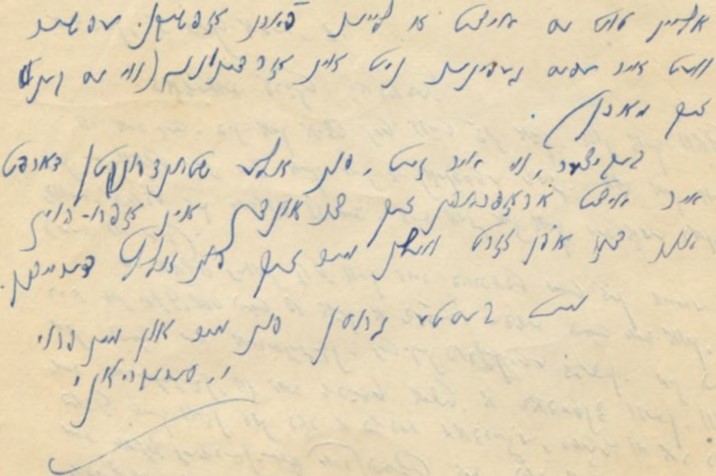
בעקיצער, ווי איר זעט, פון אלע שטאנדפּונקטן דארפט איר איצט אראָפּכאפּן זיך צו אונדז אין אָפּרו־הויז, און דאָ אפן אָרט וועלן מיר זיך פון אלץ דעריידן.
מיט בעסטע גרוסן פון מיר און פון מײַן פרוי
י. סערעבריאני
CONTENT
The Moscow Yiddish literary critic, translator, and bibliographer Yisroel Serebryani, who was staying at a sanatorium in the Ukrainian town of Irpin, near Kyiv, expresses his wish to meet Zabara. From Serebryani’s other letters from this period, it can be inferred that he was undergoing medical treatment in Irpin.
In a trustful, confidential tone, the sender writes: “I have been told that you still have unpublished texts - would you like to show them to me?” He informs the addressee that he is aware of the latter’s “significant work” in progress, namely the novel Galgal hakhoyzer (The Wheel Turns). According to Serebryani, such a masterpiece could raise Zabara to a new level, even though the latter does not think highly of himself: he is, as Serebryani puts it, “not a man at the mirrored wall”, that is, not one who occupies a place of honor in the synagogue, but rather a modest, ordinary person.
The sender discusses some argument between the Yiddish literary historian and researcher Hersh Remenik (1905-1981) in which the Sovetish Heymland's editorial board is involved; Serebryani disagrees with Zabara's opinion and suggests that they discuss the matter (which is unclear) in private.
Serebryani informs that his wife, the Sovetish Heymland's proofreader Dvoyre Grozovska, came to the sanatorium with him and both have taken a lot of work there. Grozovska was also among the proofreaders of the forthcoming collection Dertseylungen fun yidishe sovetishe shrayber [Stories of Yiddish Soviet Writers], who corresponded with Zabara on this issue separately.
Serebryani suggests that Zabara familiarize himself with the editorial and proofreading changes that are being made to his story Af gekreytste vegn [On Crossing Paths] to be included in the collection, and intervene if necessary.
FACTS AND EVENTS
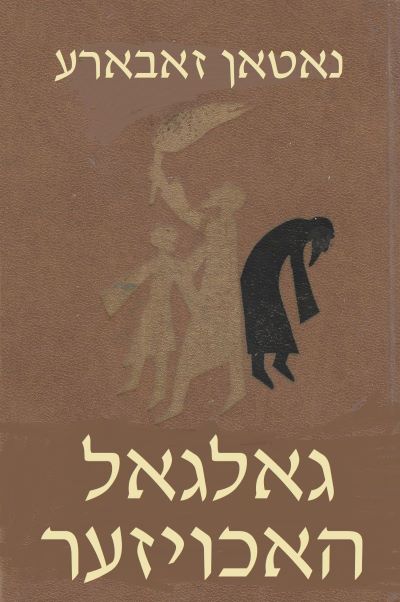
Natan Zabara’s key novel Galgal hakhoyzer [The Wheel Turns] was published in Moscow posthumously: in Yiddish in 1979 and in Yakov Volfas’ abridged Russian translation in 2004.
The novel features about a hundred characters and countless historical, ethnographic, and folkloric details; their description required familiarity with huge arrays of scientific information, access to which was rather difficult in the USSR.
The novel describes the life of the Jews of the early 13th century in various parts of Western Europe under the pressure of the Catholic Church. Special attention is paid to the Jewish community of Lunel, Provence.
Among the characters, there are Jewish scientists, writers, translators, doctors, and religious authorities. The writer managed to trace the lineage of the Zabara clan to the famous Jewish physician Yosef ben Meir ibn Zabara, who became especially famous for his Sefer Sha’ashu’im [Book of Amusements].
The novel combines an excellent artistic style and serious scientific research. Therefore, most literary reviewers as well as historians have given it the highest praise. However, its main critic was the Soviet Jewish linguist Eli Falkovich, who on the pages of Soviet Heymland demanded from a historical novel “concreteness and accuracy”. Based on Marxist theory, this scholar argued that the goals and objectives of historians and writers undertaking historical novels should be essentially the same, namely: “to teach and educate.” He suspected Zabara of trying to “embellish Jewish history” instead of punctuating the facts.
Zabara defended a more traditional interpretation, considering himself a follower of Peretz and Opatoshu: “Sometimes authors of historical novels are more righteous than dates and chronologies...” Zabara did not intend to analyze historical phenomena scientifically. His task was to synthesize long-standing history with the canons of modern creativity, to revive and actualize historical and chronicle facts and historical personalities, to artistically portray various aspects of Jewish life in Western Europe in the early Middle Ages.
Zabara also solved a complicated linguistic problem, weaving into the text necessary in the course of the narrative elements of not only the medieval Yiddish language, but also Hebrew.
![Dertseylungen fun yidishe sovetishe shrayber [Stories of Yiddish Soviet Writers]](/sites/default/files/inline-images/derceylungen_0.jpg)
The Yiddish prose collection Dertseylungen fun yidishe sovetishe shrayber [Stories of Yiddish Soviet Writers] was published in Moscow in 1969. The Moscow-based writer Tevye Gen is listed as its editor and Isroel Serebryani as its compiler. More than 60 authors appear in the book.
Zabara is represented here by a quasi-documentary story Af gekreytste vegn [On Crossing Paths] (pp. 367-381), written in 1966. It describes the meeting between the famous Ukrainian writer Lesya Ukrainka and the Hebrew novelist Mordecai Ze’ev Feierberg, who also lived in Ukraine at the end of the 19th century.
Serebryani's wife Dvoyre Grozovska, corresponded with Zabara on this issue separately.