


Shufan Xia, Davide Tamburrini, Amos Megged, Shira Faigenbaum-Golovin
Assume that a set of distributions were sampled from an unknown underlying manifold in high dimensional space. Also, assume that the dimension of the manifold is not known. Let us define the distance between samples on the manifold using the Wasserstein distance. Subsequently, we study the geometry of the manifold using unsupervised on the space of probability measures. We embedding the space of probability measures in to lower dimensional space using Diffusion operator. We illustrate that the method works well on images with ground truth data.
We apply the algorithmic apparatus to the case study of faces from the Maya codex. Codex Xolotl is an Aztec Codex that originated before the 1500s. This codex contains ten leaves, with varying amounts of faces on each (starting from 31 to 133, with a mean value of 85). After performing several pre-processing steps (among them binarization, segmentation, and denoising). Later on, we assume that the face profiles were sampled from an unknown n-dimensional manifold. Using the method described above we studying the geometry of the data and shed light on historical questions.
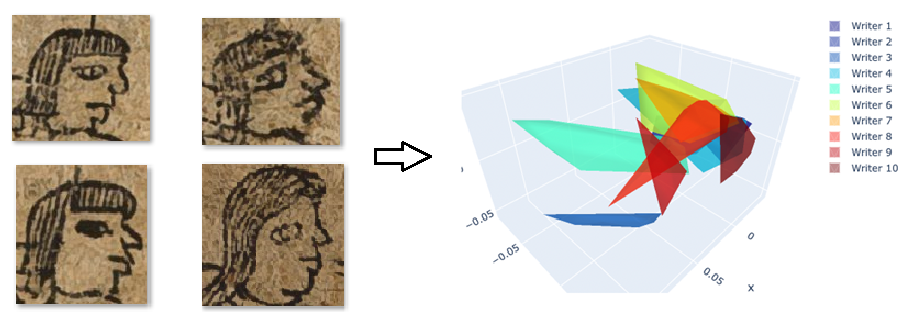
List of papers relevant papers:
1) Shedding Light on the Aztec Codex Xolotl Using Machine Learning Analysis
Xia, S., Faigenbaum-Golovin, S., Daubechies, I.,
in Amos Megged, Davide Tamburrini eds., The Aztec Codex Xolotl: Representing History and Its Protagonists, 2025.