


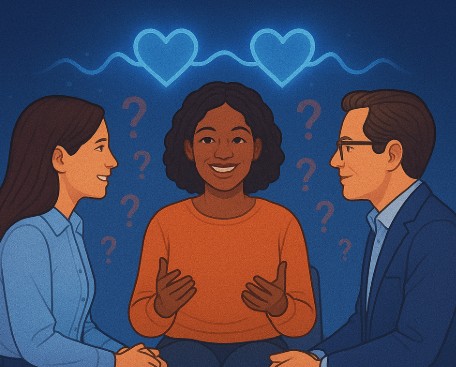
In the lab, we examine how physiological synchrony among group members reflects their emotional and functional alignment, fostering cohesion, cooperation, and collective performance. These insights advance understanding of the biological foundations of effective human interaction.
References:
Mayo, O., Horesh, D., Korisky, A., Milstein, N., Zadok, E., Tomashin, A., & Gordon, I. (2023). I feel you: Prepandemic physiological synchrony and emotional contagion during COVID-19. Emotion, 23(3), 753–763. https://doi.org/10.1037/emo0001122
Burns, A., Milstein, N., Kleinbaum, A. M., Volk, S., & Berson, Y. (2023). Biological foundations of synchrony: Implications for team outcomes. Academy of Management Proceedings, 2023(1). https://doi.org/10.5465/AMPROC.2023.18728symposium
Greenberg, D. M., Milstein, N., Gilboa, A., Cohen, S., Haimovich, N., Siegman, S., ... & Gordon, I. (2023). Improvised herding: Mapping biobehavioral mechanisms that underlie group efficacy during improvised social interaction. Psychophysiology, 60(9), Article e14307. https://doi.org/10.1111/psyp.14307
Milstein, N., & Gordon, I. (2021). Physiological synchrony and newly-formed groups’ outcomes: The moderating effects of leader justice. Academy of Management Proceedings, 2021(1), 14406. https://doi.org/10.5465/AMBPP.2021.14406
Gordon, I., Gilboa, A., Cohen, S., Milstein, N., Haimovich, N., Pinhasi, S., Siegman, S., ... (2020). Physiological and behavioral synchrony predict group cohesion and performance. Scientific Reports, 10(1), 8484. https://doi.org/10.1038/s41598-020-65670-1