


Manipulated with Spin–Orbit-Torques
Multi-State Magnetic Structures and Spin–Orbit-Torque Switching
A central research direction in our group is the design, stabilization, and controlled switching of multi-state magnetic structures, with particular emphasis on spin–orbit torques (SOTs) as an efficient and scalable writing mechanism.
Motivation
Conventional magnetic memory elements rely on two stable magnetic states defined by a single easy axis of magnetization. While this binary paradigm underpins current MRAM technologies, it fundamentally limits storage density and functionality. Increasing memory density by further device miniaturization faces intrinsic challenges, motivating alternative approaches based on multi-level magnetic states within a single element.
Our research explores a complementary route: engineering magnetic anisotropy through geometry to create multiple discrete, thermally stable remanent states, and using spin–orbit torques to switch deterministically between them.
Shape-Engineered Multi-State Magnetism
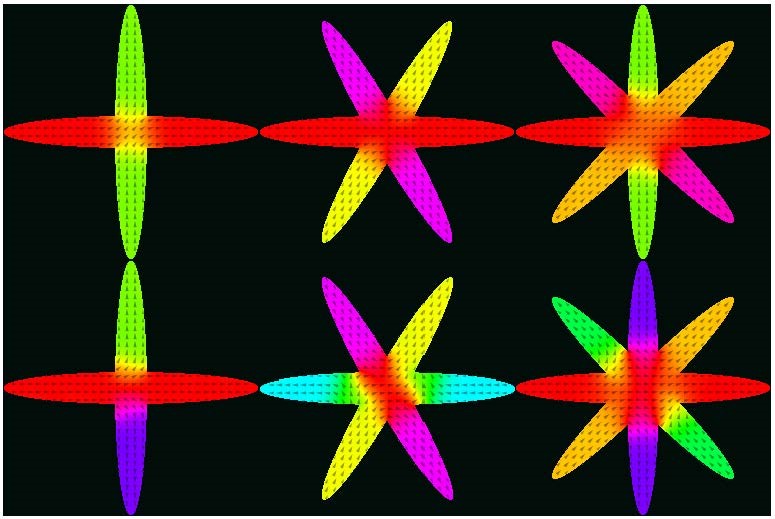
We investigate ferromagnetic micro- and nano-structures patterned into crossing elliptical geometries, where the overlap region exhibits effective higher-order magnetic anisotropy. By increasing the number of crossing ellipses, the system transitions from uniaxial to bi-axial, tri-axial, and higher-order anisotropy, supporting an increasing number of stable remanent magnetic states.
Using planar Hall effect measurements, we directly probe the magnetic configuration in the overlap region and demonstrate:
-
Four-state and six-state magnetic elements,
-
Systematic scaling of the number of stable states with structure geometry,
-
Excellent agreement with micromagnetic simulations and effective Hamiltonian models.
These results establish shape-induced anisotropy as a powerful design tool for multi-state magnetic elements
Spin–Orbit Torques as a Writing Mechanism
A key requirement for practical multi-state devices is a non-destructive, scalable switching method. We demonstrate that spin–orbit torques generated in heavy-metal/ferromagnet heterostructures provide such a mechanism.
By driving current through an adjacent heavy-metal layer (typically β-Ta), we induce spin currents that exert field-like and anti-damping torques on the magnetic structure. We show:
-
Field-free SOT switching between multiple remanent states,
-
Deterministic control of state-to-state transitions using current direction and geometry,
-
Switching currents compatible with device scalability.
This approach enables multi-state operation without the need for external magnetic fields, a critical requirement for integration into memory technologies .
Exponential Scaling of Magnetic States
Beyond linear scaling, we demonstrate that localized application of SOTs can dramatically expand the accessible state space. By selectively addressing individual ellipses—or even individual edges within an ellipse—the number of remanent states increases from 2N to 2^N to 2^{2N}, including configurations stabilized by Néel-type domain walls in the overlap region.
This exponential growth of stable states in relatively simple magnetic structures highlights the richness of the magnetic phase space accessible through local SOT control and opens pathways toward ultra-high-density magnetic memory and unconventional computing architectures
.
Domain-Wall-Mediated Switching
We further show that SOTs can induce non-local switching via domain-wall propagation, where a current applied to one part of the structure triggers magnetization reversal in a neighboring region. This mechanism reduces the required current density and introduces new degrees of freedom for device design.
Such switching dynamics are particularly attractive for multi-level MRAM, as well as for devices where information is transferred through controlled magnetic textures rather than uniform magnetization reversal.
.
Fundamental SOT Response and Device Physics
Complementing the device-oriented studies, we investigate the fundamental response of magnetic structures to spin–orbit torques, including regimes where magnetization reversal leads to a giant enhancement of magnetic susceptibility. Using harmonic Hall measurements, we uncover non-trivial torque–anisotropy interplay that becomes especially pronounced near magnetic reversal.
These results provide deeper insight into SOT-driven dynamics and point to strategies for amplifying magnetic response in future spintronic devices
Outlook and Applications
Together, these studies establish a comprehensive framework for multi-state magnetic devices controlled by spin–orbit torques, with implications for:
-
Multi-level MRAM,
-
Magnetic memristors,
-
Neuromorphic and non-Boolean computing,
-
Dense, energy-efficient spintronic architectures.
The unifying theme is the deliberate coupling of geometry, anisotropy, and spin–orbit physics to move beyond binary magnetism and toward richer, functionally enhanced magnetic systems.