


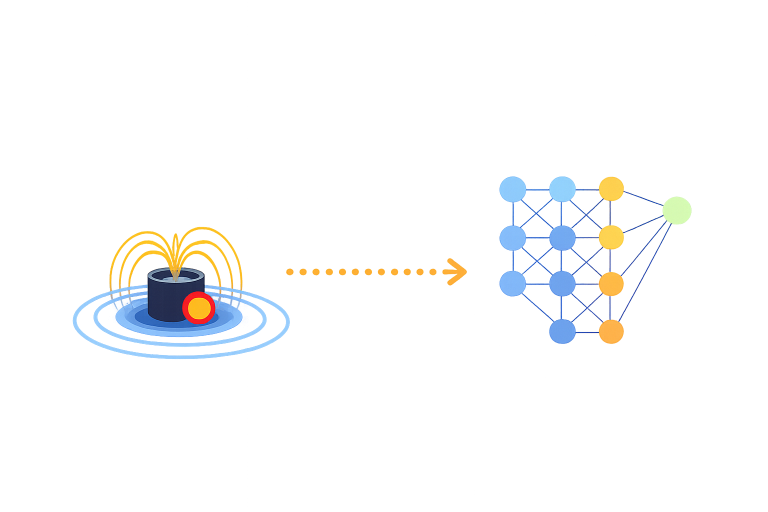
Using AI for Detection and Monitoring of Magnetic Sources
AI-Enhanced Detection and Monitoring of Magnetic Sources
A core research interest of our group is the development of artificial-intelligence–driven methods for enhancing the detection, localization, and monitoring of magnetic sources, using compact spintronic sensor arrays.
This research is carried out in close collaboration with researchers at the Soreq Nuclear Research Center (NRC), combining academic research with applied sensing expertise.
Motivation
In many practical environments—non-destructive testing, structural monitoring, enclosed systems, and electromagnetic diagnostics—magnetic sources must be detected and tracked using very limited sensing hardware. Sensor count, placement, and accessibility are often severely constrained, while the required sensitivity, reliability, and robustness remain high.
Conventional signal-processing and model-based approaches reach their limits quickly under such conditions. Our research explores how AI can be used to dramatically extend the effective capabilities of magnetic sensing systems, enabling tasks that would otherwise require far more sensors, larger footprints, or direct access to the monitored region.
Core Idea
Rather than using AI as a black box, we use it as a capability amplifier that is tightly coupled to the underlying physics. The work combines:
-
Elliptical planar Hall effect (EPHE) magnetic sensors, offering compactness and high sensitivity,
-
Sparse sensor arrays, often restricted to a small number of measurement points,
-
Physics-guided AI models, trained and conditioned using physically meaningful descriptors of the magnetic source.
This joint approach enables reliable detection and monitoring even in situations where direct imaging or dense sampling is impractical or impossible.
AI-Driven Enhancement of Detection
Within this framework, AI is used to enhance key detection capabilities, including:
-
Accurate localization and identification of magnetic sources from sparse measurements,
-
Robust discrimination between different source configurations and orientations,
-
Extraction of physically meaningful parameters such as position, geometry, and effective magnetic moment.
Our results demonstrate that AI-based processing can achieve performance comparable to systems employing orders of magnitude more sensors, effectively shifting complexity from hardware to computation.
Monitoring and Tracking in Inaccessible Environments
Beyond static detection, this research naturally extends to monitoring and tracking applications. By embedding physical structure into the learning process, the resulting models remain stable, interpretable, and robust over time. This enables:
-
Continuous monitoring of magnetic sources,
-
Sensitivity to gradual changes in position, orientation, or effective geometry,
-
Operation in closed or inaccessible environments, where direct inspection is not feasible.
These capabilities are particularly relevant for long-term monitoring and early-warning scenarios addressed in collaboration with Soreq NRC.
Broader Significance
This research establishes a general paradigm for AI-enhanced magnetic sensing, where learning algorithms are designed as an integral part of the sensing system rather than as post-processing tools. The collaboration between academia and Soreq NRC plays a central role in bridging fundamental research with realistic sensing constraints and deployment scenarios.
The overarching goal is to enable more information, higher reliability, and improved monitoring capabilities from minimal sensing hardware, using AI as a principled extension of magnetic sensing technology.